Be the first! Get the latest news and updates
A brand of


Suggestions
A brand of
*Lan L. Wargocki P. Wyon DP. Lian Z. (2011) Effects of thermal discomfort in an office on perceived air quality, SBS symptoms, physiological responses, and human performance. Indoor Air 21:5, pp 376-90
** Banbury SP. and Berry DC. (1998) Disruption of office-related tasks by speech and office noise. British Journal of Psychology 89:3, pp 499–517
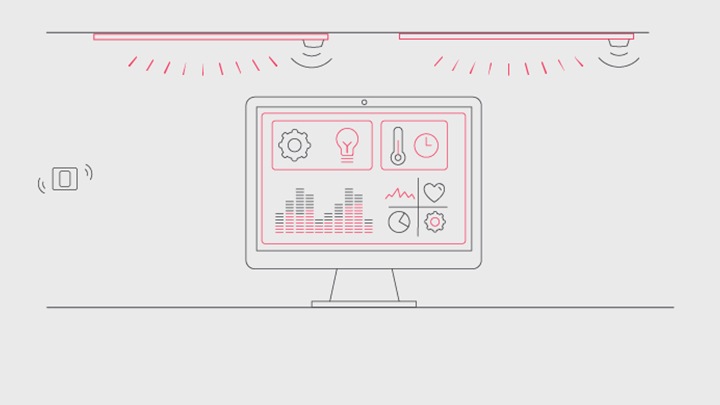
Sensor slots inside LED luminaires can be equipped with temperature and humidity sensors to provide a cost-effective way of leveraging the lighting infrastructure to create a dense sensor grid.
The sensors collect real-time data on the environment, which can be integrated with other building management systems such as HVAC to trigger direct environmental control. Data can be analyzed for further optimization of climate control systems.
The sensors are smaller than a match box and are easily upgradable on-premise with a simple click and swap via the upgradeable sensor slot. This future-ready solution, unique to Philips professional office luminaires, means there is no need to remove the luminaire from the ceiling when it is ready for upgrade, but rather the sensors can be fitted from the front of the luminaire. This technology gives organizations the flexibility to upgrade performance as new technology becomes available, or when a new tenant would like to benefit from improved functionality.
EDGE has worked with Signify from the first disruptive power-over-ethernet LED in The Edge building, towards the latest innovation in Signify light infrastructure implemented in EDGE Olympic Amsterdam. Driving health and productivity of building users through technology. The extremely accurate localization and superior people counting capabilities allow us to optimize user experience and facility management in our buildings. The new environmental monitoring capabilities are an additional contribution to our employees’ wellbeing.”
Erik Ubels, CTO of EDGE.